Electronics Weekly—Microchip MEMS Oscillators, RS Components Switcher Chips and More

Analog Devices has announced the LT8364, a current-mode 2MHz step-up DC/DC converter with an internal 4A, 60V switch. It operates from an input voltage range of 2.8V to 60V and is suitable for applications with input sources ranging from a single-cell Li-ion battery to multicell battery stacks, automotive inputs, telecom power supplies and industrial power rails.
The LT8364 can be configured as either a boost, SEPIC or an inverting converter. Its switching frequency can be programmed between 300 kHz and 2 MHz, allowing designers to minimize external component sizes and avoid critical frequency bands, such as AM radio. Furthermore, it offers over 90 percent efficiency while switching at 2MHz.
For more information, visit Analog Devices’ website.
Microchip Technology has unveiled its DSA family of automotive-grade Micro-Electro-Mechanical Systems (MEMS) oscillators that provide 20 times better reliability, 500 times better tolerance to shock and 5 times better vibration resistance than traditional quartz-based crystal devices. The DSA family also includes a multiple-output MEMS oscillator, offering users a system that can replace multiple crystals or oscillators with one device.
MEMS oscillators are built entirely with standard semiconductor processes, giving systems the same reliability and stability as integrated circuits. Crystal oscillators rely on the thickness of the crystal blank inside the oscillator, making them susceptible to vibration damage with longer lead times and fixed frequency. This can delay product development or release times if a designer needs to make a last-minute frequency change.
Additional technical specifications are available on Microchip’s website.
EW—Design Edition—Cadence PCB Design Software, Mentor RTOS System & More

Cruden has developed a simulation tool for automotive R&D that combines hardware-in-the-loop (HIL) setups and driver-in-the-loop (DIL) simulators. The company’s approach is to fuse its Panthera simulator software with the hardware interfacing capabilities of dSPACE hard real-time systems and the open and real-time-capable dSPACE ASM (Automotive Simulation Models) simulation tool suite.
The Panthera ePhyse HRT toolbox includes a Simulink block set optimized for use on the dSPACE system. It is a setup IO between the dSPACE platform and the simulator environment. The only hardware change required is the replacement of the conventional Windows-based computer (which sends output to the motion, audio and visual systems) in the soft real-time setup with a dSPACE system.
Additional technical specifications are available on Cruden’s website.
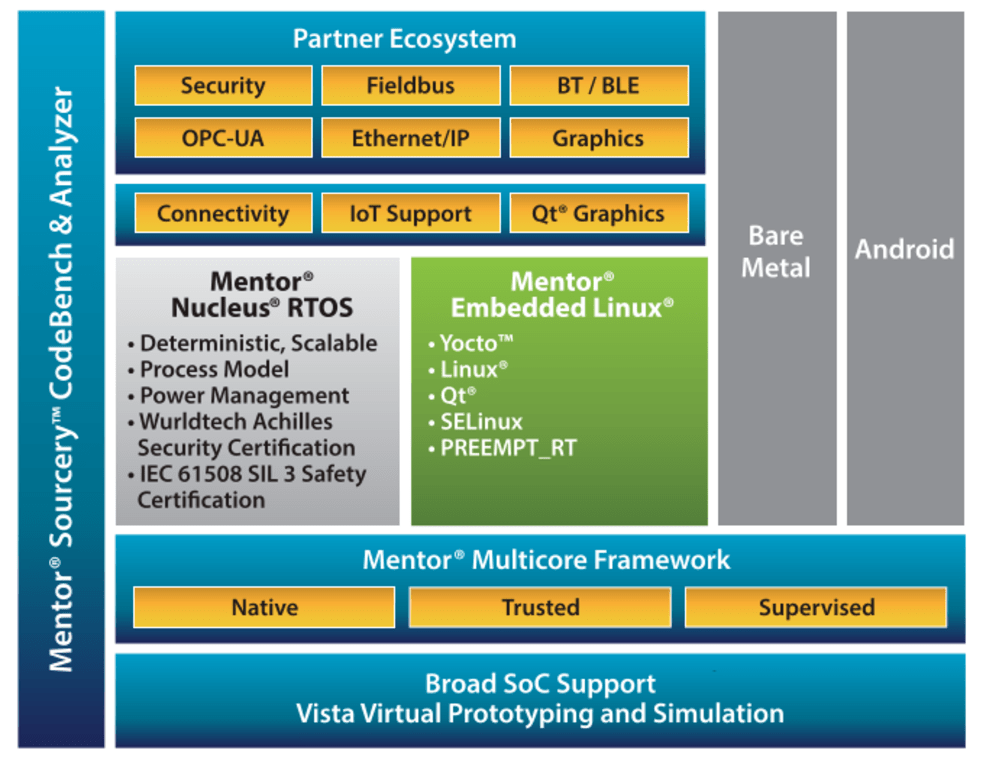
Mentor Graphics has announced the update of its Nucleus real-time operating system (RTOS) targeting applications based on 32- and 64-bit processors on multicore SoCs for industrial, medical, automotive, airborne and Internet of Things devices. This Nucleus RTOS release extends the Nucleus Process Model to support asymmetric multiprocessing (AMP) and symmetric multiprocessing (SMP) on Arm Cortex v8-A processors and multicore SoCs.
The process model increases system reliability by isolating faults to individual software subsystems, preventing other software subsystems from being impacted. Support for 64-bit processors and multicore SoCs lets developers utilize the Nucleus Process Model for AMP and SMP designs on 64-bit silicon. In addition, this release includes support for the LWEXT 4 journaling file system with 64-bit, addressing maximum files sizes of 16 terabytes.
For more information, visit Mentor Graphics’ website.
 Vincent Charbonneau